

Conversations With an Architect About Home Automation


Home automation – is it something that has become more popular? With the rise of technology, have we become more accustomed to incorporating it into our everyday lives?
This week in “Conversations with an architect”, I sat down with Mel Gawi to better understand this.
Mel, as an architect designing luxurious residential homes, have you noticed the rise in home automation, and why do people choose it?
“Most homes we design are quite large. A 1300 sqm home can easily have over 160 circuits for lights and fans. Some circuits have 4-8 downlights, so a house of that size could end up with 250 or more downlights. Add heating, a music system, TVs, security cameras and gates to the equation. That’s a whole lot of lights, each easy enough to operate on its own, but managing them separately can become a full-time job. Most of our clients want home automation, and it often comes down to size and comfort. A large home with good home automation is easier to run. At bedtime, turning off the main living-area lights with a click on your mobile becomes a luxury you soon get accustomed to. Checking who’s at the gate while you’re in a meeting room, or adjusting your heating before you get home - all great features to have, don’t you think? For me, this is a luxury worth investing in. You’ve invested in a house, and now you want to be comfortable using all that technology has to offer.”
With all this technology, how does it affect the design? I’m thinking of architecture as well as interior design.
"As architects and designers, we design rooms around how they'll be used. How does the client use lighting in a room? Where is the music system best placed, where should the speakers be placed, how is the temperature controlled, and so on. With a well-programmed home automation system, the owner will easily access and control these elements. The design itself must also consider the placement of all these elements. Switches, speakers, and other elements need to be planned early, alongside finishes and the ceiling layout. Another example is the control screen, which must be well positioned and work conveniently with the wall design. We resolve all these details early on. It is harder to try and fit equipment after the interiors are finished, and it means less work later on."
I was fascinated by how many lights go into a large home. I’d assume that choosing the right light fittings is important.
“Oh, it is very important. It’s particularly important, I’d say, when you want proper dimming. Although a light fitting might be labelled as 'dimmable', it could still be far too bright at its lowest setting, or it may start flickering. Suitable and well-vetted light fittings from well-established manufacturers, such as Brightgreen, become vital. A light fitting matched to a compatible C-Bus dimmer makes it possible to achieve very low dimming levels.”

Why is this important?
“It makes all the difference in how a room is perceived. I’ll give you an example. In the kitchen, cooking or cleaning, a stark light is great, but it isn’t as cosy to have your dinner in bright light as it is when you dim it down. With automation, save the settings and command your smartphone to activate a midnight scene, or a dinner scene or whatever you choose to call it!”
That sounds dreamy.
“It sure is, and when these things are planned when designing the lighting and the controls, that’s when you get the benefit of both. We try to understand each family and how they use a space, and we ask questions like which rooms are used most, how often they entertain, and whether music is an important element. How they’d like to use the technology matters just as much. Would they use a wall switch, or a phone or perhaps a screen? While this can sound overwhelming, the design needs to be flexible so that a guest can turn on a switch, and the commands are easy enough to memorise. And, from experience, I’ve learned that they need to be easy to use for more than one person in the household.”

When you say you can control a light from a phone, is that the same thing as automation?
“It is one way to operate a switch, but automation is more. Automation is when you set something to happen on a schedule or based on a setting. When you program your lights to come on at sunset or when your hallway lights light up just enough when someone walks through at night, this is automation. For example, when you press the leave home setting and it lets you leave certain lights on while turning off the heating, that's another example. It needs to work for you, and you should be able to override it. It is there to serve you, not to complicate your life.”
Is there a particular reason you mentioned the C-Bus system before?

“When I designed and built the Parkwood home, which I’ll use as an example, I used Clipsal C-Bus, part of Schneider Electric, for lighting and electrical controls. I felt secure knowing it had an Australian development history dating back more than 30 years. This suited the scale of the house well. For me, a programmable and adjustable wired system was important. I also like that C-Bus is continuously developing. Their 5500AC2 controller offers more programming and connection options, and it links to Apple Home and Home Assistant, for instance. While other systems are also established, this seemed the most suitable for the Parkwood house.”
I’d like to know a bit more about the C-Bus system. Could you explain it in layman's terms without being too technical?
“Sure. Switches and sensors send instructions along a dedicated control cable. Then, modules operate the electrical circuits. A relay turns something on or off, and a dimmer adjusts a light's brightness. The power for these is supplied by separate electrical wiring. So, a switch could be programmed to operate either one light or a group of lights. Or it could be programmed to operate a saved setting. You can also extend the programming through the controller and connect it to Home Assistant, Apple Home, Google Assistant, Control4 or Amazon Alexa. What’s good to know is that the wall switch functions will still work locally, without access to the internet; should it go down, you’re not stuck or prevented from using lighting! When I press a light switch, I don’t want the instruction travelling to Germany or the United States and back.”

I’ve heard people talking to Siri, commanding the app to operate lights. Tell us more.
"Many families use Apple devices daily and are familiar with them, so it makes sense to integrate these devices into home automation. It is easy to operate, and you don’t need a different app for everything, since it can organise lights, heating, and other equipment by room. Some equipment connects directly, while some needs a bridge. A useful option is Homebridge, which can bring supported devices into Apple Home through compatible plugins. For the functions that are connected to Apple Home, you can say 'Hey Siri, turn on the kitchen lights', or 'Hey Siri, open the gate', or 'Siri, set the dining lights to 25%'. It is handy when cooking or carrying something, as all you have to do is ask. You can also say 'Hey Siri, set the family room temperature to 20 degrees and play ‘Billie Jean’ by Michael Jackson'."
Any other significant features you’d like to share?
“Well, yes. A location-based automation setup lets your phone tell the system when you arrive home. If you set it up correctly with compatible equipment, it can give you the royal arrival: opening your gate and garage door, turning on entry lights, and even playing your favourite tune if you wish! You decide what to include and tailor it to your liking. Who needs a butler when you have home automation? You can also include temperature control. At Parkwood, we used Brivis and Mitsubishi Heavy Industries systems. You can integrate their controls into a broader home automation setup. In large spaces, it's easier to manage the areas you actually want to control. From your phone, you can adjust which areas to heat through a programmed routine. As for the music, we used WiiM amplifiers and streamers for different audio areas. Simply put, the amplifier powers the speakers, and the streamer brings music into an amplifier or existing audio system. These can also be grouped so the music is played in certain areas, a nice feature to have when you have guests moving between dining and barbecue areas or the garden, for instance. Again, compatible AirPlay functions allow you to play music from Apple devices, depending on the model. Here, the planning becomes important again: the speaker coverage, how the sound travels between spaces, and how to integrate this with the ceiling layout and interiors.”
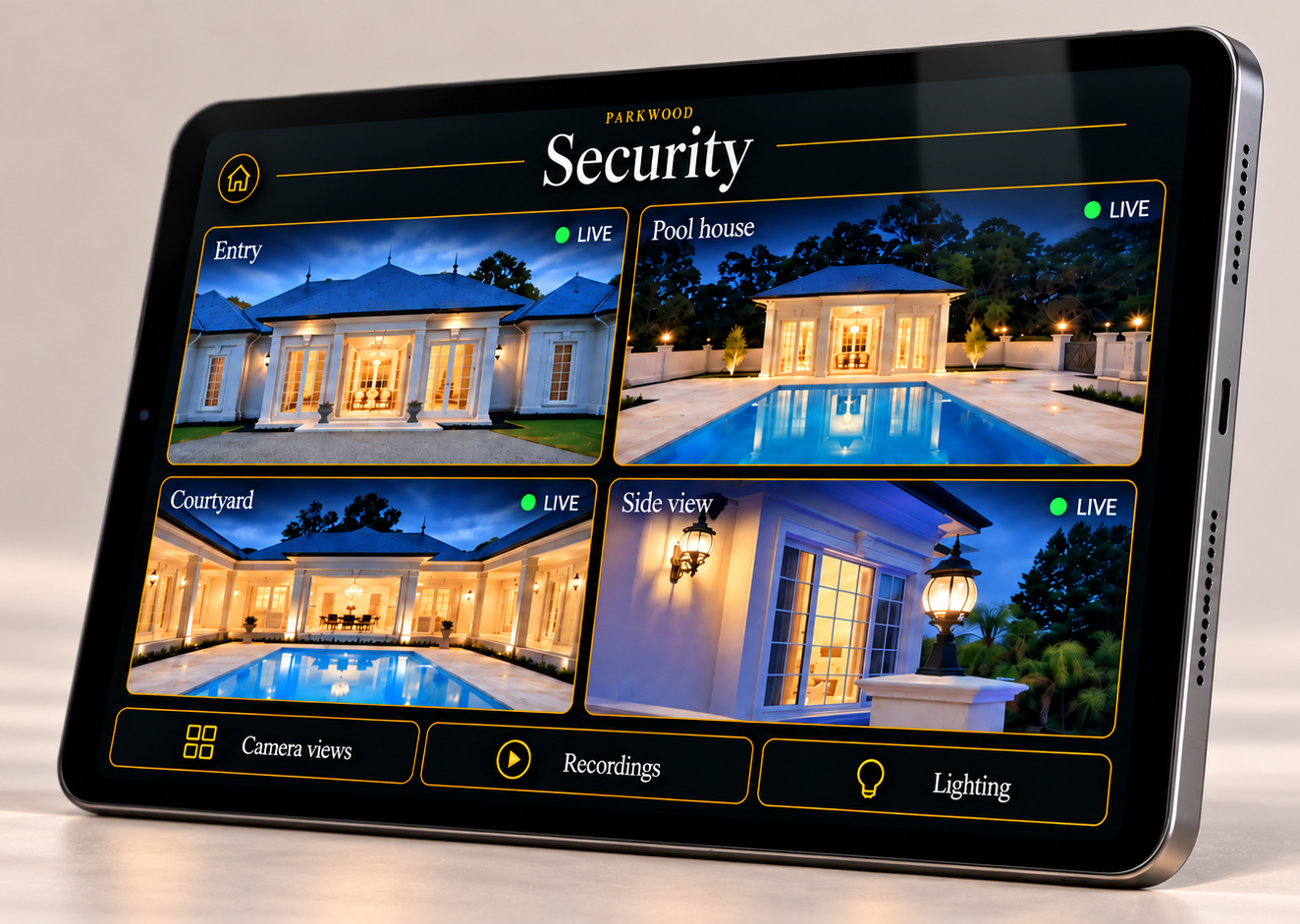
Home automation involves a lot. What can you tell us about security?
“As I mentioned, gates can be controlled, but the intercom system is important. I have used DoorBird intercoms on several occasions. It lets visitors press a button to connect to your phone, where you can see them through the camera and speak with them. It's handy when the delivery guy comes while you’ve stepped out. Gates are controlled through this app. The Hikvision cameras are another feature that connects to your home automation system. The cameras send video footage over the home network, and the recorder stores it. It is convenient to check your entryway, or any part of your property, along fences and gates, and you can do it live, or it can be stored. Motion alerts can trigger lights, music or an alarm response if programmed correctly. It can all be programmed according to your needs.”
Will you need a professional company or person to organise all this?
“I’d recommend a professional programmer if you are not tech-savvy. I enjoy programming, although it’s not my profession. In the past, I’ve spent hundreds of hours setting up my C-Bus system because I wanted full control, but sometimes I had to rely on professionals for expertise beyond my experience. Today, I use AI to help me write code, troubleshoot, and plan how to connect different parts. It helps me plan a strategy and makes it easier to tackle things I struggled with before. If you are considering making changes to a system, it’s good to ask the supplier beforehand what can and cannot be altered and what requires their involvement. It could save you time and money."

Any final words to anyone considering home automation?
“I’d ensure that your architect, interior designer, and electrician plan this together. An experienced electrician who knows automation is important, regardless of who programs it. Consider cost and durability; also check compatibility with the smartphone you use.
Check the support you will receive and who will maintain this. Keep physical controls for everyday tasks and allow access for servicing. Always document installation and programming.
Finally, proper commissioning is important. Remember that it has to be tested, checked, and make sense. Make sure it is all labelled in the control room and that your family knows how to use it.
A house design with an integrated automation system is, in many ways, the perfect home. The benefits owners get from both the house design and the automation satisfy me as an architect, whether it is the way the space works or the sensory experiences they carry into their everyday lives. I'm passionate about architecture, good design, and what completes a home in the times we live in—automation."

Mel Gawi is the Principal Architect at Architeria Architects. Architeria designs luxury residences, classical and contemporary homes, acreage properties and substantial residential projects across Melbourne, Sydney and beyond.
Interior Design Director


Comments